
The analysis on this page comes from iVerify, North Star Group’s patent-pending site-screening and origination program, which converts corridor, freight, parcel, flood, soil, and logistics data into developer-grade site packets. The full screen behind it is the iVerify site report for this node.
Current stage
North Star Group · iVerify · pre-validation screening
What this screen examines
This is a worked example at the I-10 × SR-90 node near Benson. On a ~20-acre site, a controlled truck-and-trailer yard prices at roughly $12-$15/night; at ~70% occupancy that is about $386K-$483K of stabilized NOI, a 14-17% yield on cost that clears a 12% return floor on the yard alone. The first move is validating the market; once the parcel is controlled, the held land earns as trailer/IOS parking until a buyer commits.
Deal economics at a glance
Exits
The yard is built owner-direct and stabilized as a controlled truck-and-trailer operation. Once it cash-flows, there are three ways to exit, and the market picks the best one at the time:
| Exit | What you sell | Why it works |
|---|---|---|
| 1. Sell the whole asset | The entire stabilized parking-and-storage operation as a single income property | A fully-leased IOS asset is what an institutional or 1031 buyer wants; cleanest story, and as one asset it can price a little stronger |
| 2. Carve the entrance pads | The ~5 acres at the lot’s entrance to a fuel/retail/service operator, parking sold separately | The full lot has captured the customers; an operator pays a pad premium for access to that captive traffic, on top of the yard’s income value |
| 3. Develop and sell the best use (conditional) | A parcel at this node that clears the development screen (~25 acres), on which North Star develops the highest and best building itself, a logistics or industrial build to suit, a service or retail building, or a travel-center format, leased to a creditworthy tenant on a triple net basis and sold as a stabilized asset | North Star develops it, signs a creditworthy triple-net tenant, and sells the stabilized asset; a credit net lease sells at a lower cap rate than the yard, so the value is higher, and that spread sits outside the gain figure below |
Illustrative planning figures from the validation model, not a projection of return. Values rest on achieving the rate and occupancy below; the exit cap is the market’s call. A point estimate would be false precision; the output is a range.
The whole thing turns on the nightly rate, which is the variable you can actually validate. At a $12-$15/night band and ~70% occupancy, the yard clears a 12% return floor on its own, across the entire band, not just at the top:
| Rate | Stabilized NOI | Yield on cost | 12% floor | Yard gain @ 9% cap |
|---|---|---|---|---|
| $12 / night (floor) | ~$386K | 13.7% | clears | ~$1.31M |
| $14 / night (mid) | ~$451K | 16.0% | clears | ~$2.00M |
| $15 / night (top) | ~$483K | 17.2% | clears | ~$2.34M |
Revenue math (base $14/night): 180 spaces × $14/night × 365 nights × 70% occupancy = ~$644K gross; less 30% operating expense = ~$451K NOI. Sale values are net of a 4% cost of sale.
The demand bar is lower than it looks. At the $14 mid-case the yard clears the 12% floor at ~52% occupancy and breaks even on a 9% sale at ~41%; even at the $12 floor of the band those thresholds are ~61% and ~48%. So the 70% assumption carries meaningful cushion across the band, subject to validating actual demand, surface cost, access, and operating expense. And while the entrance pads wait for an operator, they run as trailer/IOS parking: the held land earns, it does not just carry.
| Metric | Figure | Read |
|---|---|---|
| Direct total development cost (yard incl. land) | ~$2.81M | Owner-direct, preferred path |
| GC retail cost | ~$4.85M | Stress / reference case; weakens economics |
| Stabilized NOI ($12-$15/night, 70% occ) | ~$386-483K | Controlled yard only |
| Yield on cost | ~14-17% | Clears the 12% floor without any land credit |
| Yard income value @ 9% cap | ~$4.1-5.2M | Exit 1, NOI ÷ 9% (~$4.3-5.4M) less 4% cost of sale |
| Yard sale gain | ~$1.3-2.3M | Value less ~$2.81M cost |
| Entrance pad (5 ac) | ~$0.5M gain | Exit 2, ~$0.6M value less ~$0.15M basis |
| Gross gain after stabilization | ~$1.8-2.8M | Yard + entrance pad, before carry |
Exits 1 and 2 are income-based; they are what the gain figure above rests on. The third is a development play, and it pencils the way any site does, on the whole screen: location, access, visibility, economics, demographics, competition, and site conditions. The node already carries much of it: a primary I-10 corridor location, and the existing Love’s, busy and long-established. The node already works, with room read for a second operator. Several thousand trucks/day pass the door as the demand base (to be confirmed against current ADOT counts), and the nightly-parked trucks are a captive fueling base in their own right. Where a parcel here also clears the acreage and the rest of that screen, North Star develops the best use on it, a logistics or industrial build to suit, a service or retail building, or a travel-center format, and signs a creditworthy tenant to a triple net lease. A credit net lease sells at a lower cap rate than the yard's conservative 9%, so the stabilized asset is worth more; North Star, the merchant developer, realizes that spread at sale. That is a structurally higher ceiling, set by the tenant credit and the lease and not quantified here, so it sits as upside rather than in the gross-gain range above. The format sets the buildable acreage: a full travel-center wants about 25 acres and will take about 20, a build to suit runs to the tenant box, so the broker target is a site or assemblage sized to the format, which also enlarges the yard economics beyond the ~20-acre example modeled here.
Known validation items
These are diligence items, not unknowns being glossed; each is a normal validation step behind site control, before material spend:
| Item | Why it matters |
|---|---|
| Access / driveway approval | Truck-yard viability depends on ingress/egress and ADOT coordination at the site entrance |
| Turning geometry on the selected parcel | A long-narrow parcel can lose usable acreage to circulation; shape drives the stall count |
| Zoning / permitted use | Yard, IOS, fuel, repair, and septic/restroom uses may be treated differently |
| Water / sewer / septic | Relevant once restroom, repair, or operator/fuel use is in play |
| Drainage / retention | Geotech and percolation; caliche may require drywells or controlled-release outfall |
| Dust, lighting, security | Standard paid-yard scope; gravel-yard dust control can carry permitting/neighbor conditions |
| Operator interest | The operator-exit case strengthens materially with 3-5 real operator calls or LOI targets |
| Demand (rate × occupancy) | The single highest-leverage item: confirm ~$12-$15/night at ~70% at this node |
Order of work
Market first
The screen comes first, before any spend on site control, diligence, or construction. Does the Benson I-10 × SR-90 node support a paid truck-parking, IOS, and operator-pad use at all? If it holds, the next step is choosing a parcel and an ownership path, then sizing a control-and-diligence budget to that parcel. The worked example here uses parcel 12311001U. Control is funded once the node, the parcel, and the terms line up.
| Step | Decision |
|---|---|
| 1 | Confirm the market screen: node demand, rate, occupancy, and operator interest support a paid truck-parking / IOS / operator-pad use. |
| 2 | Select the preferred parcel and ownership path; size the site-control and diligence budget around that parcel. |
| 3 | Secure property control: option, purchase contract with due-diligence period, ground lease, or phased takedown. |
| 4 | Confirm civil / geotech scope and validate site layout once a control path is realistic. |
| 5 | Update budget and proforma; decide whether to exercise, assign, ground lease, JV, or hold for operator pad. |
| 6 | Bring in construction capital only after market, site control, and validation survive. |
Representative conceptual site plan
Site layout

| Zone | Acres | Function |
|---|---|---|
| Entrance operator pad | ~5.0 | The corner at the lot entrance, sold or ground-leased to a fuel, convenience, truck-service, repair, or retail operator who wants the captive traffic (Exit 2) |
| Controlled truck-and-trailer yard | ~10.0 | Initial use: truck parking, trailer drop / IOS staging, fleet parking, detention, and demand generation |
| Support / utility / IOS overflow | ~4.94 | Utilities, generator, restroom/septic service, overflow detention, and IOS expansion, usable functional land, not a separate sale |
On the example parcel, a ~20-acre site is treated as a phased truck-service platform. The corner at the lot entrance is reserved for the operator pad. The rest runs as the controlled truck-and-trailer yard. Drainage is folded into the yard, and the support land stays usable as IOS and overflow rather than sitting idle. Acreage and layout vary by the parcel chosen.
Profit Model
Build cost
At the Exit 302 node, the site runs two ways. The first is a truck-and-trailer yard, the simplest use to validate: it cash-flows on its own, proves the demand any larger use rests on, and carries its own income exits. The second is the parcel best use, developed by North Star and sold as a stabilized asset leased to a creditworthy tenant on a triple net basis, which trades at a lower cap rate than the yard. That path is a reasonable prospect at this node, not a stretch: the Love’s already operates here as a busy, established truck-stop anchor, on a primary corridor about 30-38 road miles off the southeast Tucson freight base. What it asks for is a parcel here that clears the development screen (the full feasibility set, not just visibility) plus the ~25 acres the format needs: an acquisition target the broker works to, not a feature of a site in hand. The yard path stands on its own; the developed lease is the higher one, where a fitting parcel turns up. Which is highest-and-best is a validation question, not a claim the page makes.
These cases assume a control path on the parcel is in hand or in reach; the spending that confirms them is staged behind site control (see Market first, then site control).
| Case | Purpose |
|---|---|
| Initial yard-only case | Tests whether controlled parking / staging can carry the initial project |
| Seeded operator-pad case | Tests whether the yard increases the value and attractiveness of the entrance pad |
The budget model compares two delivery paths: conventional GC retail and owner-direct procurement with construction management. Direct procurement assumes the sponsor buys major components directly where practical: aggregate/base, fencing, lighting, gate systems, generator, restroom/septic service, security, and site components. The purpose is to show whether the project remains inside the required NOI-to-cost screen after real civil and operating costs are validated.
The model runs the same two delivery paths, owner-direct and GC retail. Owner-direct procurement reduces modeled development cost by roughly 40-45%, about $2.0M, versus the GC-retail stress case. The return and exit figures are in Deal Economics above; the dashboard below shows the build. Illustrative planning figures from the validation workbook; not a projection of return.

Entrance pad
Exit values
Under Exit 2, the ~5 acres at the lot’s own entrance sell separately as an operator pad. A full yard puts a steady crowd of paying drivers at the entrance: fuel, food, and service demand an operator can reach from the corner. Until a buyer commits, the pad runs as trailer drop and IOS staging, so the held land earns. The remaining support land is functional: utilities, detention, and IOS overflow folded into the operation.
| Scenario | Meaning |
|---|---|
| Low, bulk-land credit | Conservative case: value the pad as raw land only |
| Mid, operator pad | The busy lot has captured the customers; an operator pays for access to them |
| High, develop and sell | Where a parcel at this node clears the development screen, North Star develops the best use, leases it to a creditworthy triple-net tenant, and sells the stabilized asset at a lower cap |

Development thesis
An existing node
Benson is an existing I-10 truck-service node with a documented overnight-parking gap and an established stop economy.
The Love’s and motel cluster confirm that drivers already stop at this interchange. I-10 and SR-90 create the corridor movement. Tucson, about 30-38 road miles west, is the larger distribution, freight, load-unload, repair, and service market. Benson can function as the lower-friction staging and overnight point before or after Tucson.

Demand evidence
Rate and occupancy
The nightly rate is the deal’s key variable. Three things back the $12-$15/night figure: corridor volume, documented-thin public parking, and live in-corridor pricing.
| # | Fact | Source |
|---|---|---|
| 1 | Corridor volume. I-10 at this interchange carries 34,308 vehicles/day (average daily traffic, 2024); SR-90 carries 10,827. I-10 is a primary national freight corridor linking Southern California to Texas and the Southeast. | ADOT traffic counts |
| 2 | The shortage is overnight-peak, and documented. The survey counts public and private parking separately: the public side, rest areas and public facilities, not the private truck stops, runs about 155 spaces across 9 sites within ~100 miles, a thin overnight backstop when the paid lots fill. Nationally, all parking together runs roughly one space per 11 trucks, concentrated in the Hours-of-Service window. The private Love’s here fills at that peak and keeps daytime room. | FHWA Jason’s Law survey / BTS (public inventory) |
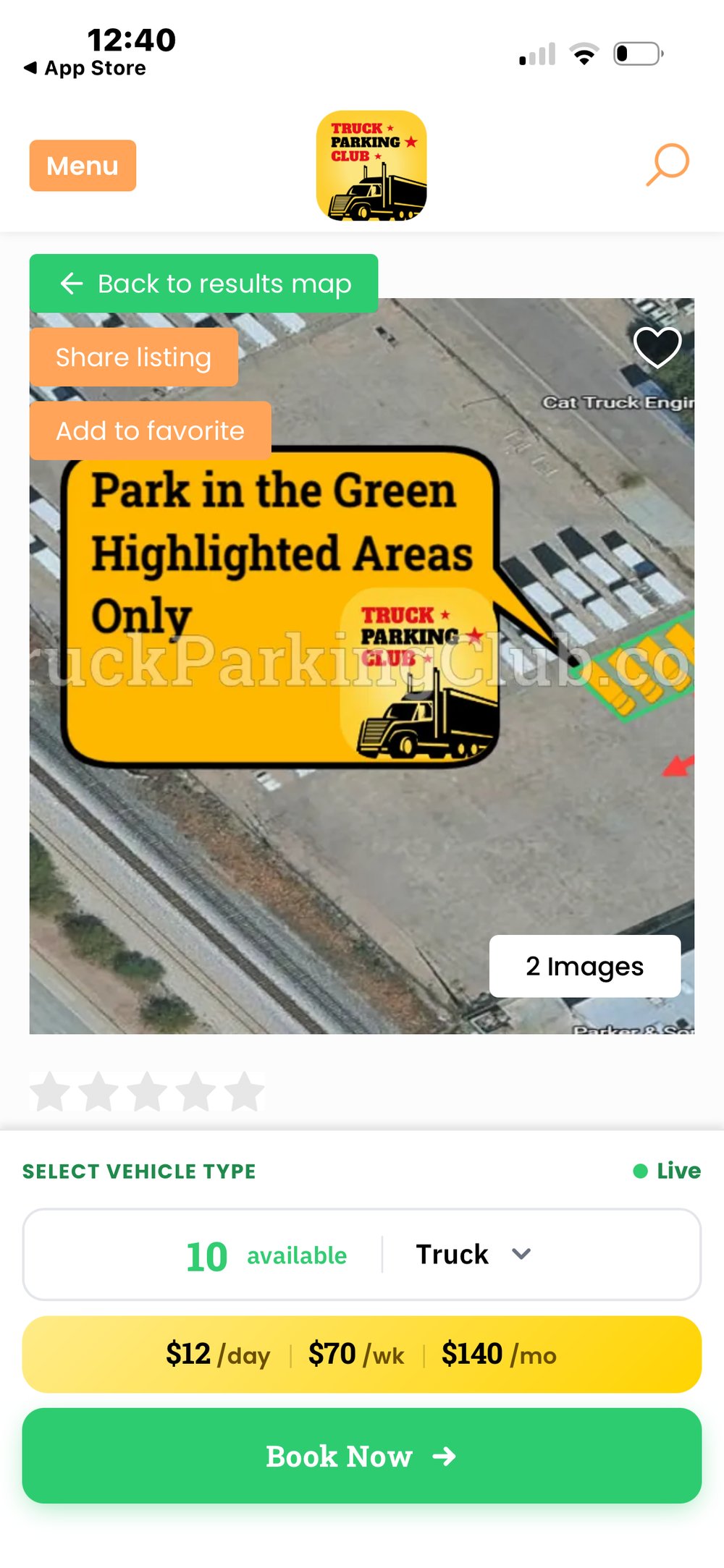
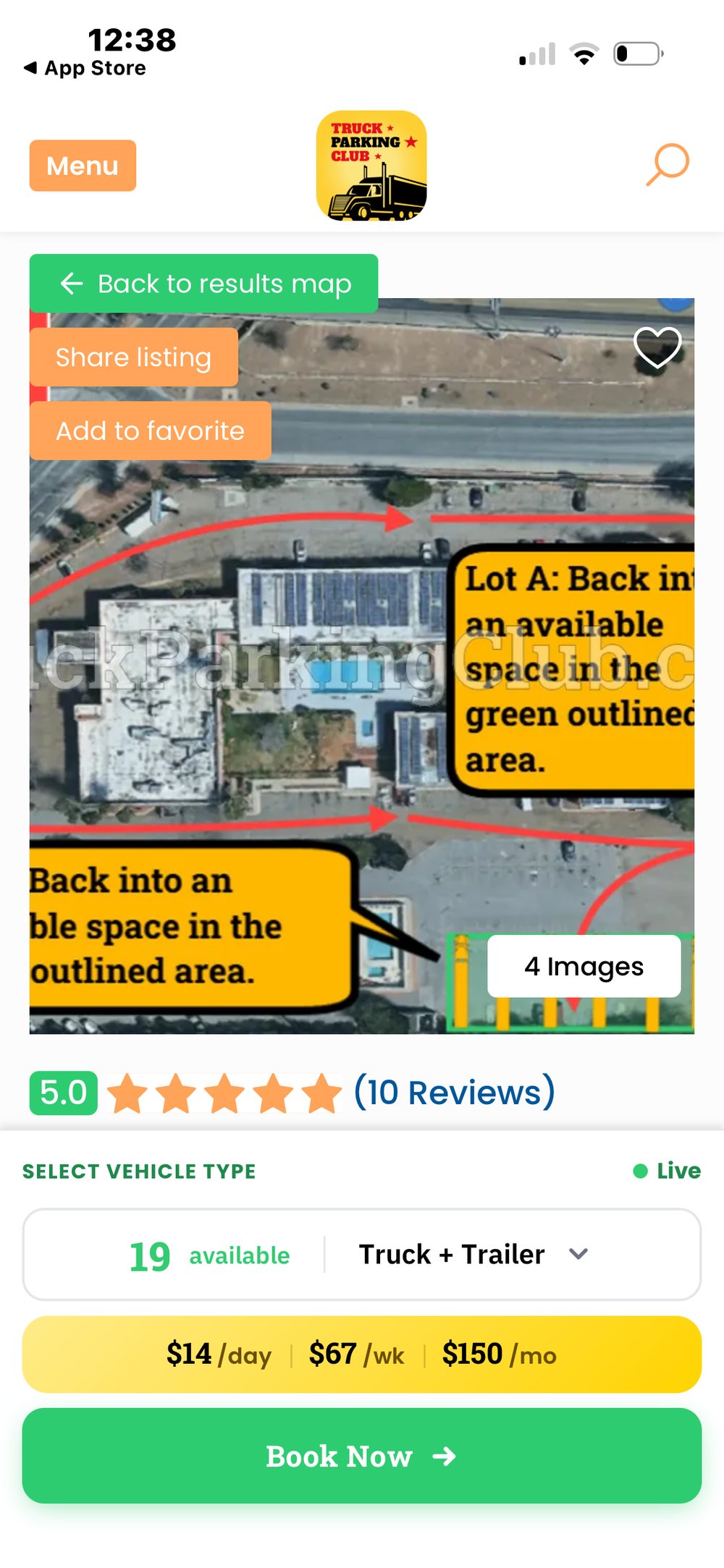
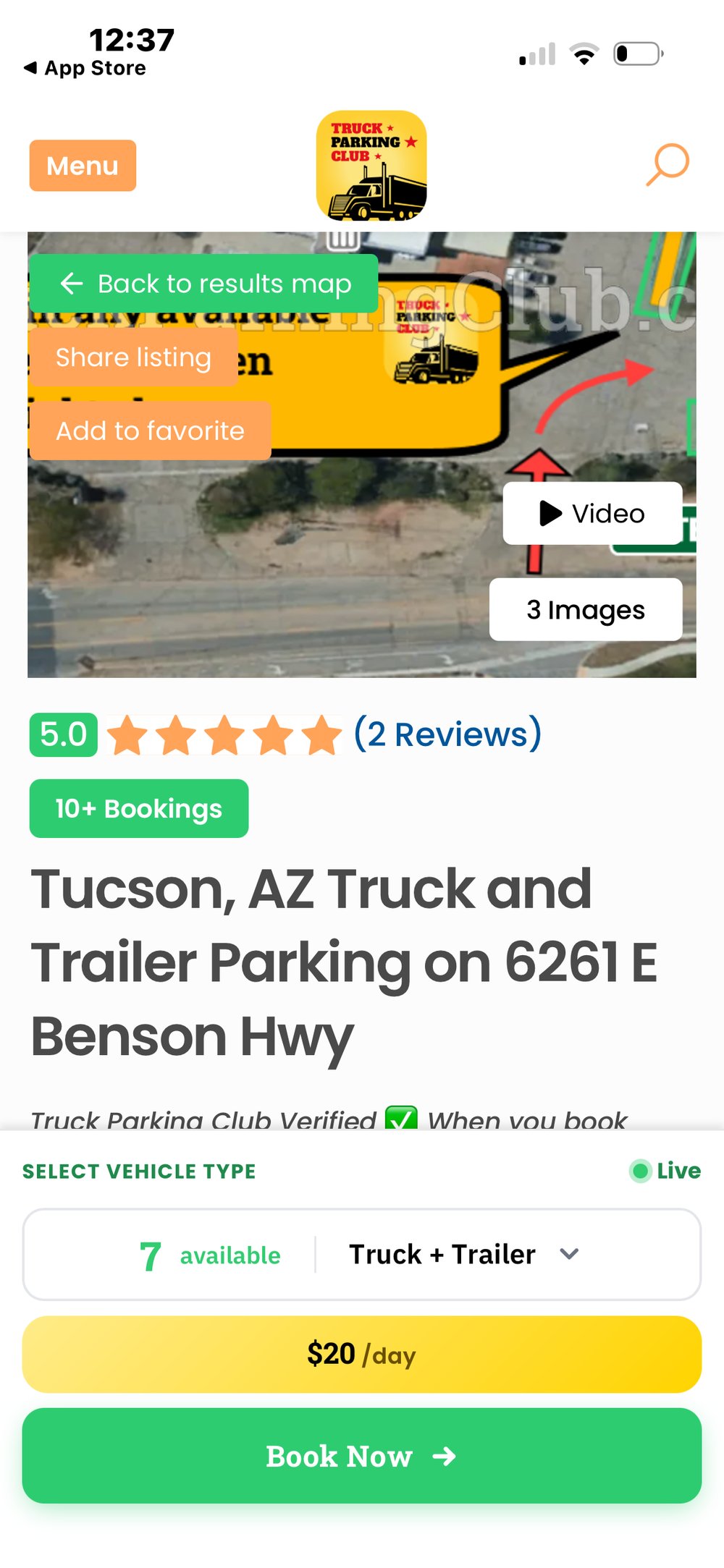
| 3 | Rate is observed in-corridor. Paid truck-and-trailer parking already lists in this I-10 corridor at $12-$20/night, clustering at $12-$15, with live availability and active bookings. The model sits in the middle of what the corridor charges today; one lot is already at $20. | Truck Parking Club marketplace |
Live corridor rate comps
Actual paid listings in the I-10 Tucson-Benson corridor, pulled from the Truck Parking Club marketplace:
| Listing | Nightly | Monthly | Note |
|---|---|---|---|
| I-10 lot, Truck + Trailer | $14 | $150 | 5.0★, 10 reviews |
| I-10 lot, Truck + Trailer | $15 | $200 | 4.7★ |
| I-10 lot, Truck | $12 | $140 | live availability |
| Tucson, Truck + Trailer | $20 | - | 5.0★, 10+ bookings |
Live listing screenshots from the Truck Parking Club marketplace in the I-10 Tucson-Benson corridor. Tap any listing to enlarge.
Occupancy, observed at the node
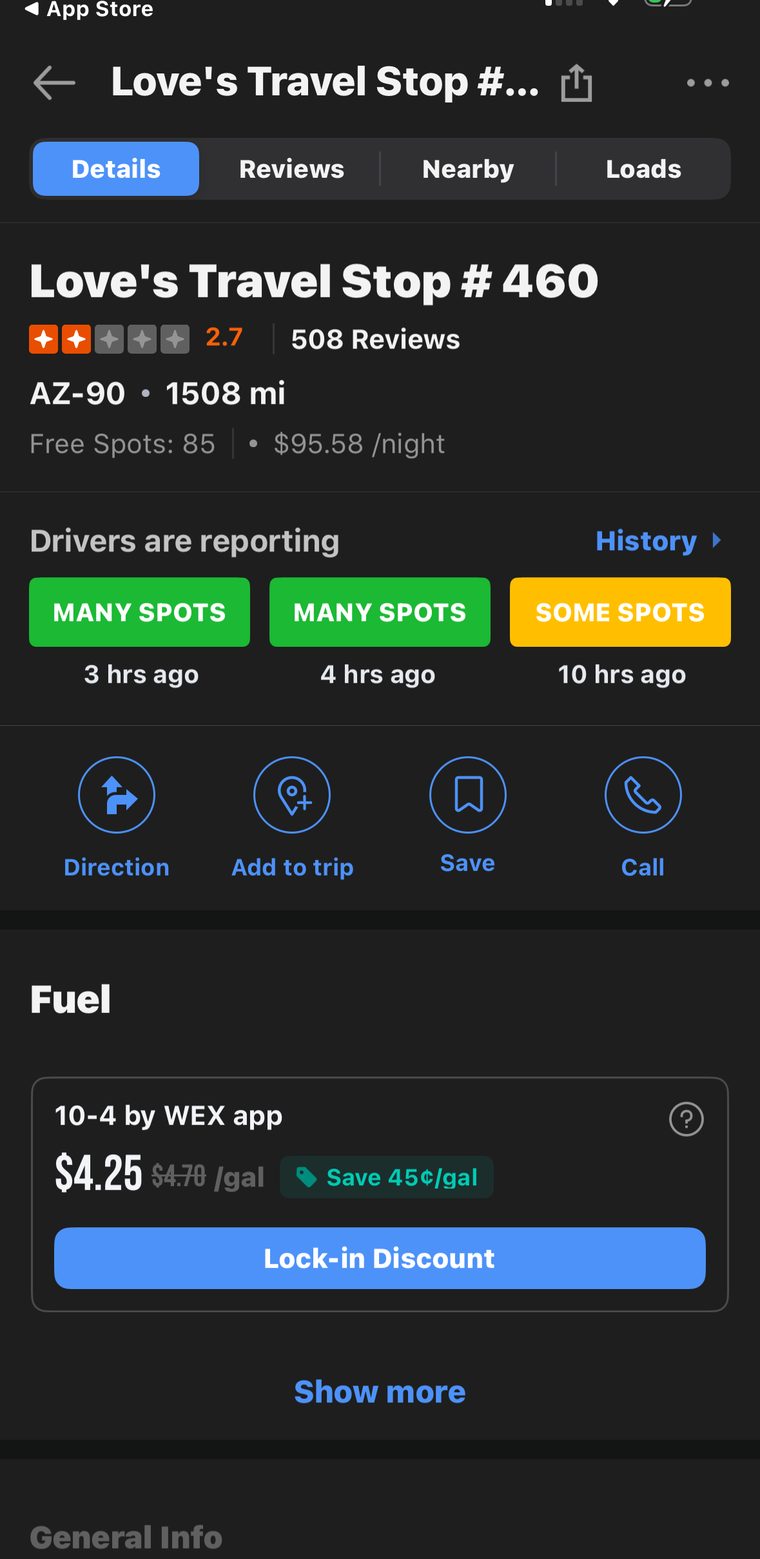
Rate is backed; occupancy is the other half of the case. Trucker Path’s driver reports and fill predictions for the lots at and around this interchange give a direct read. These are crowd-reported bands (Full / Many / Some) and an app prediction, not a metered count.
At the interchange, Love’s #460 (AZ-90) predicts Usually Full at its overnight peak: Monday and Tuesday nights run full from roughly 8pm past midnight, then eases to “Many” by mid-morning, when about 85 spots sit open. Its parking scores 2.6/5 across 500+ reviews, a free, first-come lot with no way to reserve a spot or drop a trailer.
Trucker Path reads at and around the interchange, driver reports and logged history. Tap any shot to enlarge.
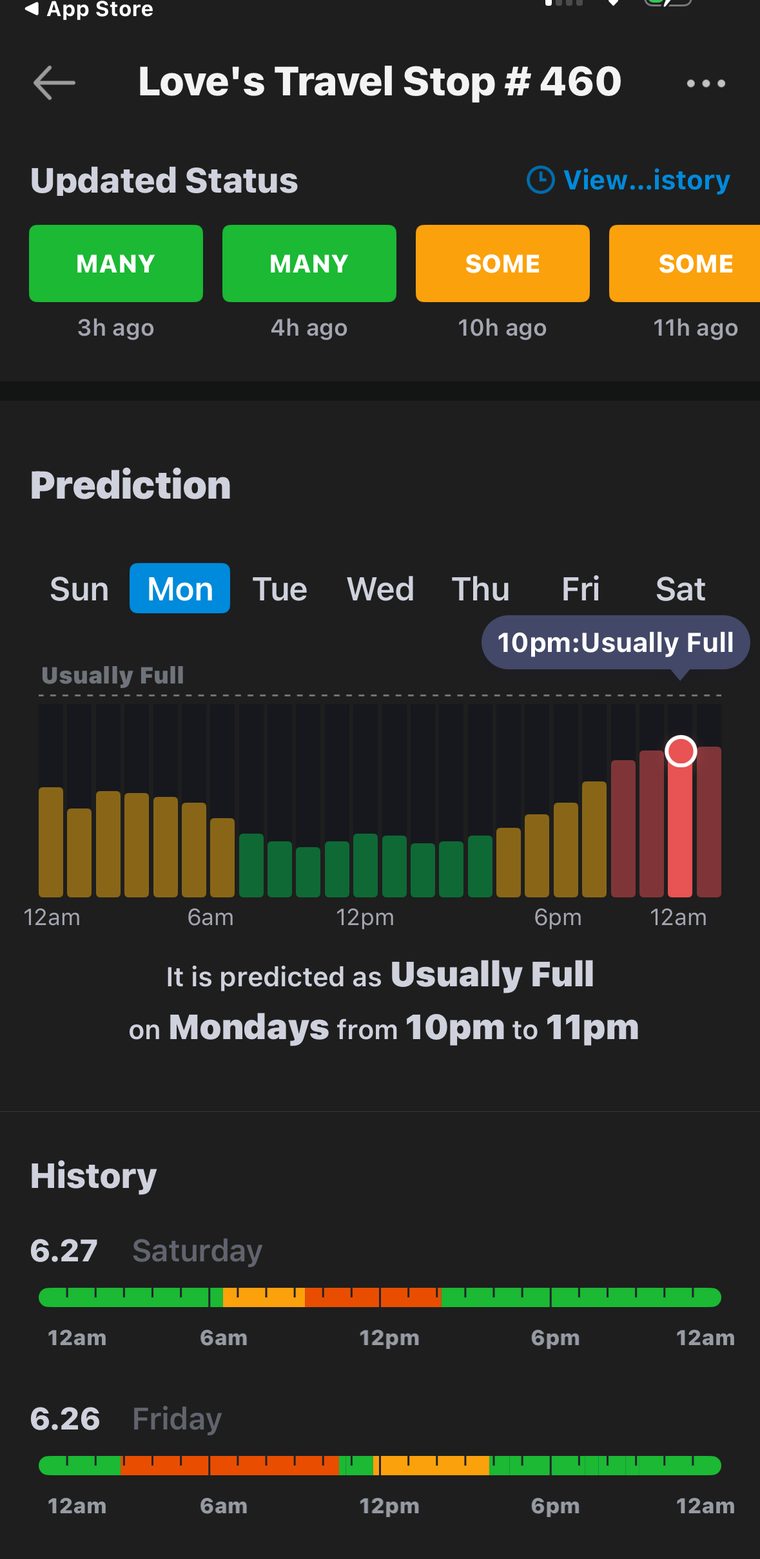
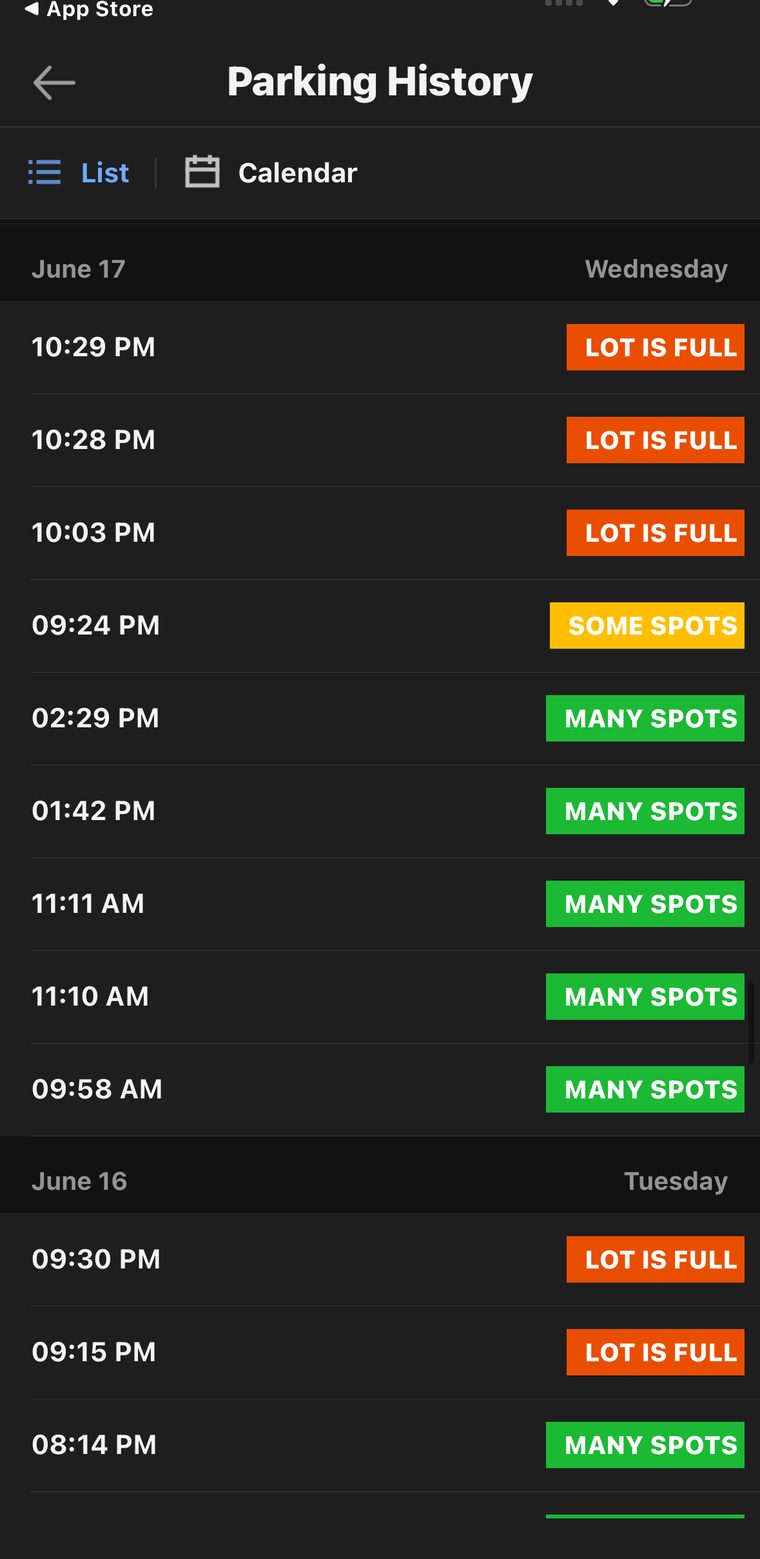
The lots around it read the same way, and drivers here already pay to park:
| Corridor stop | Spaces | Live read |
|---|---|---|
| Love’s #460, Benson (SR-90 / Exit 302) | ~85 free | Predicts Usually Full overnight |
| Vail Steakhouse, I-10 Exit 279 | small | Full recent, then Many |
| Triple T, Tucson, I-10 Exit 268 | 300 | Many → paid-only after 4pm |
| Pilot #1178, Tucson, I-10 Exit 273 | 9 | Full |
| Pilot #593, Tucson | 15 | Full, paid-only |
| Pilot #609, Eloy, I-10 Exit 208A | 228 | Many, paid-only |
In that table, the small free lots read Full and the branded stops go paid-only overnight. Drivers on this corridor already pay to park, which is the willingness-to-pay the $12-$15/night band rests on. The fill concentrates in the evening and overnight windows, so the 70% stabilized figure is an average sitting beneath peaks that already reach capacity.
Driver behavior favors this kind of site. A Class 8 driver near an hours-of-service limit will not thread a 70-foot rig through city streets; the preference is to pull off the interstate, park, and roll. That favors an interstate-adjacent rural yard at this node over in-town lots.
The capture needed is small. The yard needs about 126 paid trucks a night (180 spaces at 70%) to clear its return floor, a small share of 34,308 vehicles/day on I-10, in a corridor where public overnight parking is documented-thin.
Where this still needs work: Trucker Path reports bands and a prediction, not a metered occupancy count, and the reads cluster on free lots; a reservable interstate-adjacent yard is a cleaner product than any of them. A metered occupancy figure and the truck-specific share of the 34,308-vehicle/day count remain validation items. What has moved is the direction: the node fills at night, and the corridor already pays to park.
For illustration
Example parcel
The parcel below shows how the screen reads a real candidate, size, shape, access, ownership. It is here to illustrate the method, not because it is listed, available, or selected. Shape drives the layout: 12311001U (~19.94 ac, long and narrow) versus 12311001W (~29.18 ac, closer to the interchange and more rectangular, which lays out a yard more efficiently).
| Item | Example screen (12311001U) |
|---|---|
| Owner | Carillion Realty Corp |
| Total area | 19.94 acres |
| Approx. dimensions | 540′ × 1,722′ (long and narrow) |
| Location | North side of I-10, Tucson-Benson Hwy corridor; ~0.8 mi to I-10 × SR-90 (Exit 302) |
| Mapped floodway | 0% |
| Mapped AE / AH floodplain | 0% / 0% |
| Mapped hydric soil | 0% |
| Dominant soils | Sasabe 74.2% / Bodecker 25.8% |
| Parcel relief | 28.8 ft |
| To be verified | Road access, utilities, zoning, flood depth (BFE) |

This parcel is not being presented as fully engineered. It is being presented as a strong candidate parcel. The preliminary screen is favorable: adequate gross acreage, close interchange proximity, clean mapped floodway and AE/AH screen, no mapped hydric soil, and parcel-level relief that appears manageable for a developer-grade grading review. The next work is normal validation: geotech, grading ROM, zoning, owner terms, access/driveway confirmation, utility confirmation, and operator/rate validation.
Soils and grading
Grading, not blasting
The central engineering question is not whether trucks can reach the interchange. The central question is whether Sasabe / Bodecker soils and the parcel grade can support an economical truck-yard surface section.
| Soil | Parcel share | Plain-English read |
|---|---|---|
| Sasabe | 74.2% | Very deep, well-drained fan-alluvium soil; validate clay content, compaction, plasticity, and surface performance |
| Bodecker | 25.8% | Very deep, excessively drained sandy/gravelly alluvial soil; validate gradation, compaction, drainage, and base design |
Validation tests
| Test | Purpose |
|---|---|
| Test pits / borings | Confirm actual soil, caliche, rock, clay lenses, loose alluvium |
| Proctor density | Confirm compaction behavior |
| Plasticity index | Identify clay / shrink-swell / pumping risk |
| R-value or CBR | Support pavement / aggregate-base design |
| Gradation | Determine reuse of on-site material |
| Soluble salts / sulfate | Relevant if cement treatment or concrete is used |
| Cut/fill estimate | Confirm whether grading can balance on site |
| Surface-section ROM | Compare gravel, aggregate base, millings, cement-treated base, asphalt-at-throat, or hybrid section |
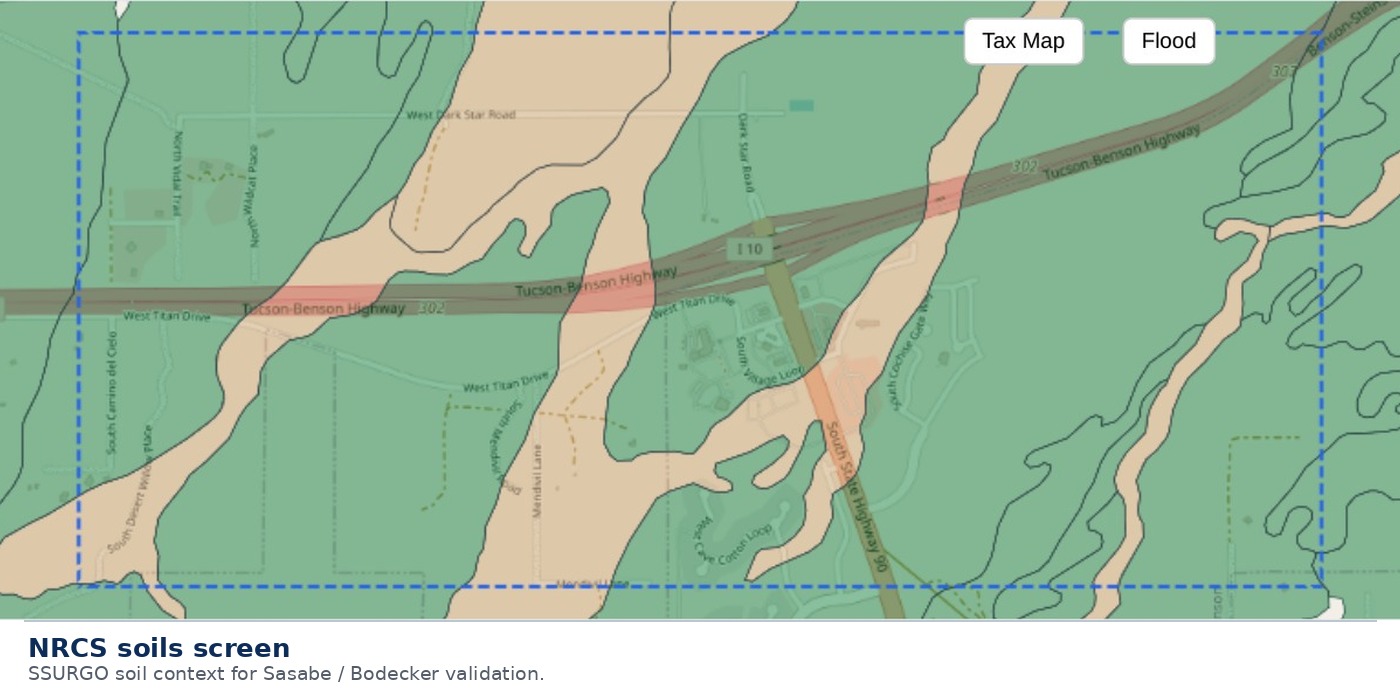
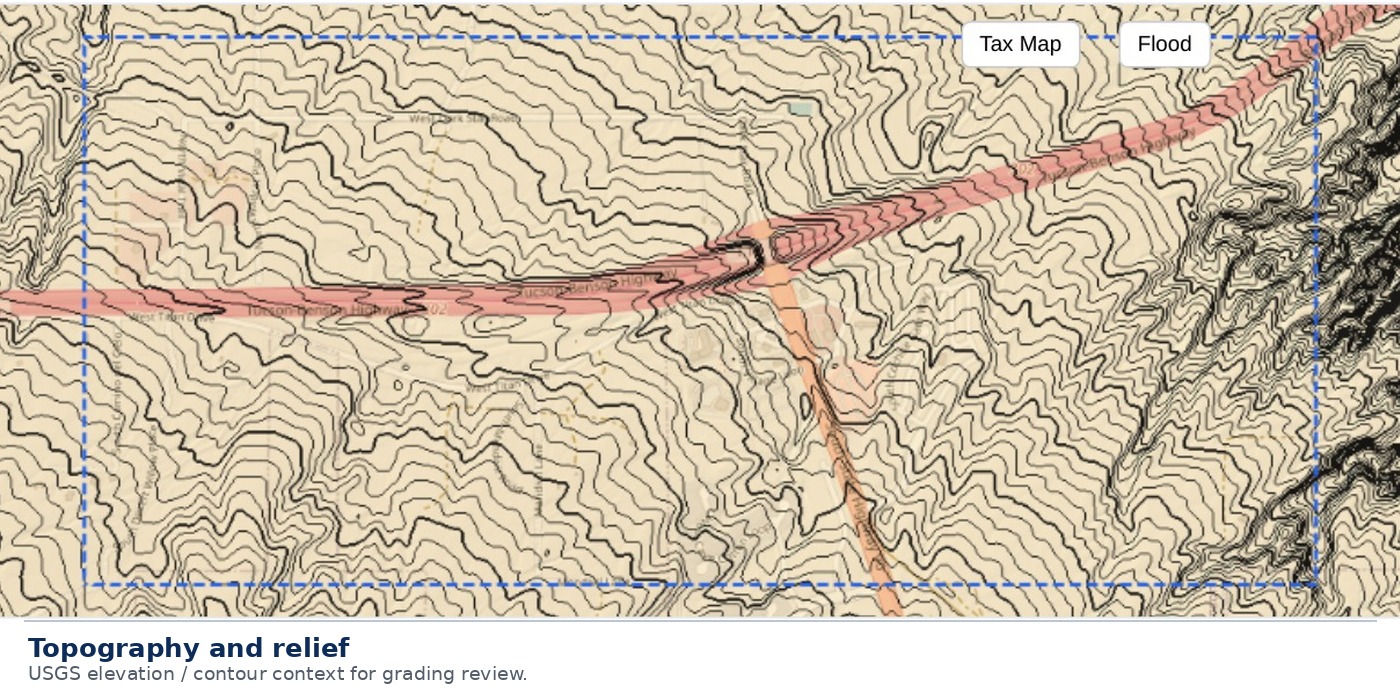
This does not read as a rock/blasting thesis from the mapped soil names. It reads as a desert alluvial grading and surface-section question. The validation package converts that question into geotech, civil ROM, and local contractor pricing.
Phase 2 · site control + diligence
Control, then diligence
This is Phase 2 work. After the market screen survives and a preferred parcel and ownership path are identified, validation spending follows an acceptable option / PSA / ground-lease path. Once the site can be tied up, this budget buys the evidence needed before construction equity is exposed.
| Item | Purpose |
|---|---|
| Developer site sketch | Establish phased site logic |
| Civil ROM | Grade, drainage, entrance, detention, surface section |
| Geotech allowance | Confirm soil performance and base design |
| Rate comps | Validate the $12-$15/night rate band against local demand |
| Operator calls | Test yard, fleet, trailer, IOS, fuel, and service demand |
| Zoning confirmation | Confirm permitted-use path |
| Owner contact | Option, PSA, ground lease, phased takedown, or pad structure |
| Utility check | Power, water, septic/restroom service, generator, lighting, telecom |
| Updated proforma | Confirm whether the project still clears the return screen |
The candidate advances only if site control, validation, and economics all remain inside the screen.
Powered by iVerify Patent Pending
The source data
The screen behind this page is the live iVerify report for this node. iVerify pulls the public data and the table shows what each layer becomes in it.
| Raw data | iVerify output |
|---|---|
| Traffic counts | Corridor demand signal |
| FMCSA carrier records | Local carrier / trailer / power-unit demand |
| Public truck-parking inventory | Supply constraint signal |
| Parcels | Owner / size / value / geometry review |
| FEMA flood | Buildable-footprint screen |
| NRCS soils | Soil / grading risk screen |
| USGS elevation | Relief and civil-cost signal |
| Lodging / truck services | Overnight-stop and service-node signal |
| Logistics / warehouse layers | Market context |
| Broker tool | Parcel shortlist and action list |
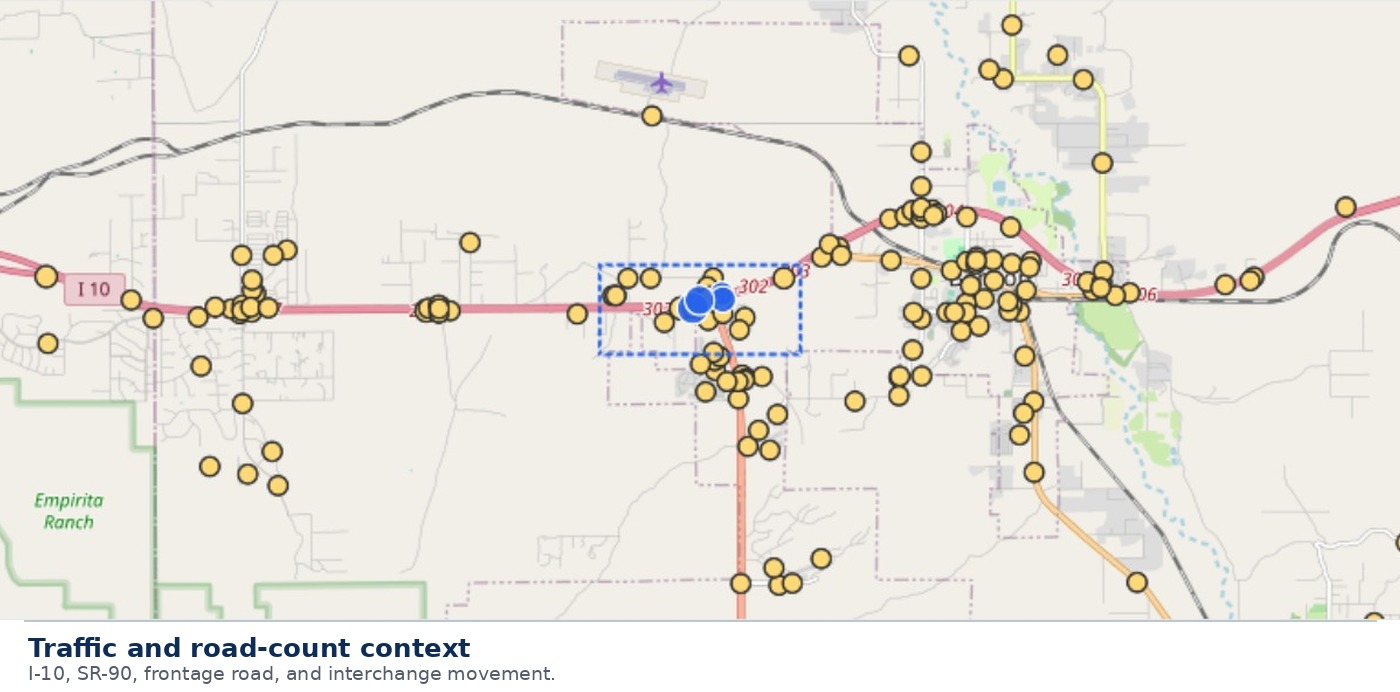
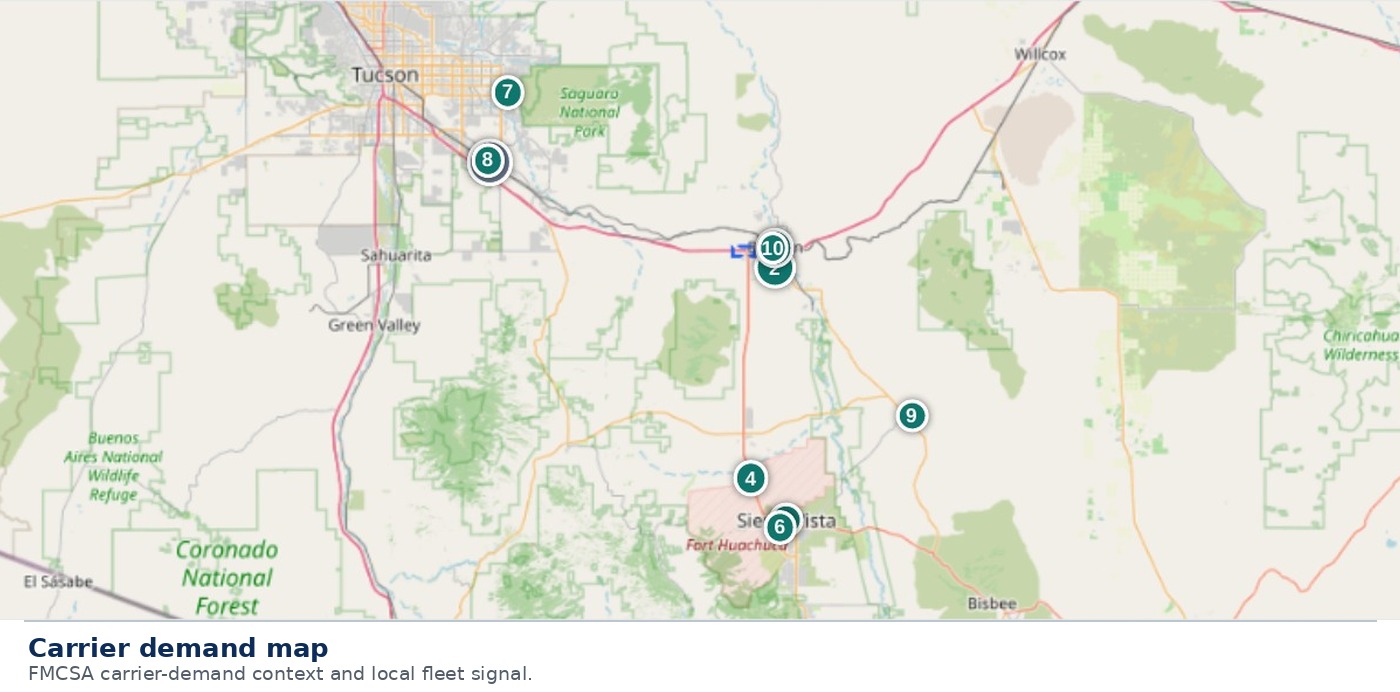
The page shows the outputs, report, screenshots, parcel facts, method. The raw tables, carrier exports, scoring weights, schema, and extraction logic stay inside the engine.
Backup Documents
Backup, on request
iVerify Report 23
Full technical screen: traffic, parcels, flood, soils, topo, carriers, lodging, truck-service context, broker tools.
Investor Brochure
Investor / validation packet: current model, nightly-rate and two-exit story.
Excel Validation Budget
Direct procurement vs. GC retail, land optionality, economics, validation budget.
Conceptual Master Site Plan
Phased plan with entrance operator pad, rear controlled yard, support / utility / drainage reserve.
North Star Group / iVerify
Developer-led method
North Star Group is a developer-led systems and real estate platform focused on practical site origination, development strategy, infrastructure, and applied AI tools. iVerify is North Star’s corridor-screening and parcel-origination system for freight, IOS, truck-service, and logistics-land opportunities.
Michael Hoffman is the principal of North Star Group, Inc. His background includes real estate development, systems integration, and invention work, with issued patents and pending housing / site-screening concepts. The Benson package reflects a developer-led method: screen the corridor, isolate candidate parcels, identify the demand signal, prepare a validation budget, and advance only if the economics survive real-world checks.
Contact
Michael Hoffman
North Star Group, Inc.
Fairhope, Alabama
701-770-9118
michaelh@nsgia.com
www.nsgia.com
This is a pre-validation screening package. Construction capital, final site control, final engineering, and final operator structure are not being requested at this stage.